At Reddish Hall School, we pride ourselves on our students receiving a broad and balanced curriculum.
With opportunities to develop the skills and knowledge that they are interested in as well as ensuring that they leave with the personal qualities, skills and qualifications needed to progress into college, apprenticeships or employment.
Read about our Inclusive Classroom (PDF)
KS3 & KS4 Combined
ASPIRE KS3 & 4
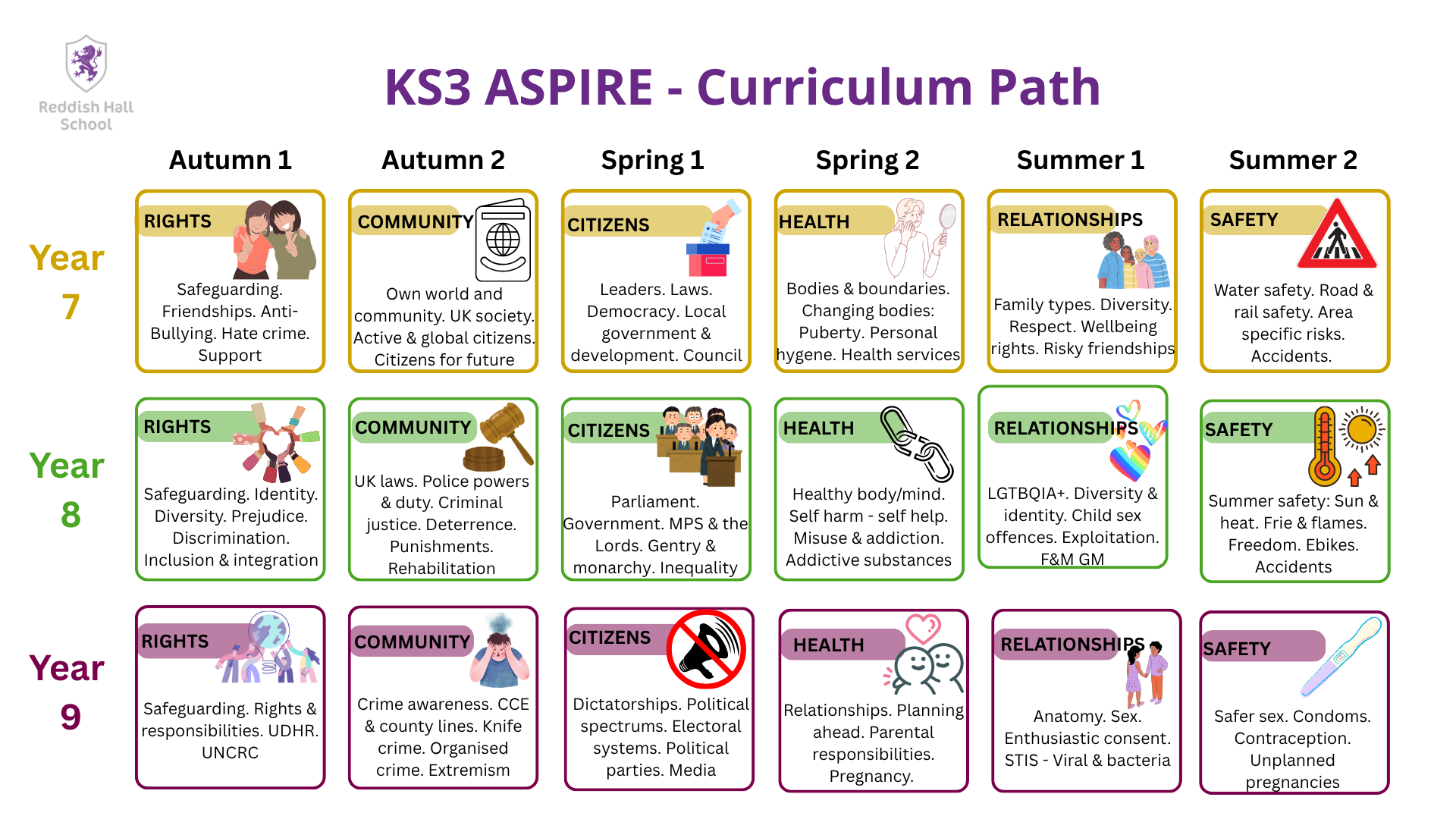
🔗 Download PDF version of KS3 ASPIRE
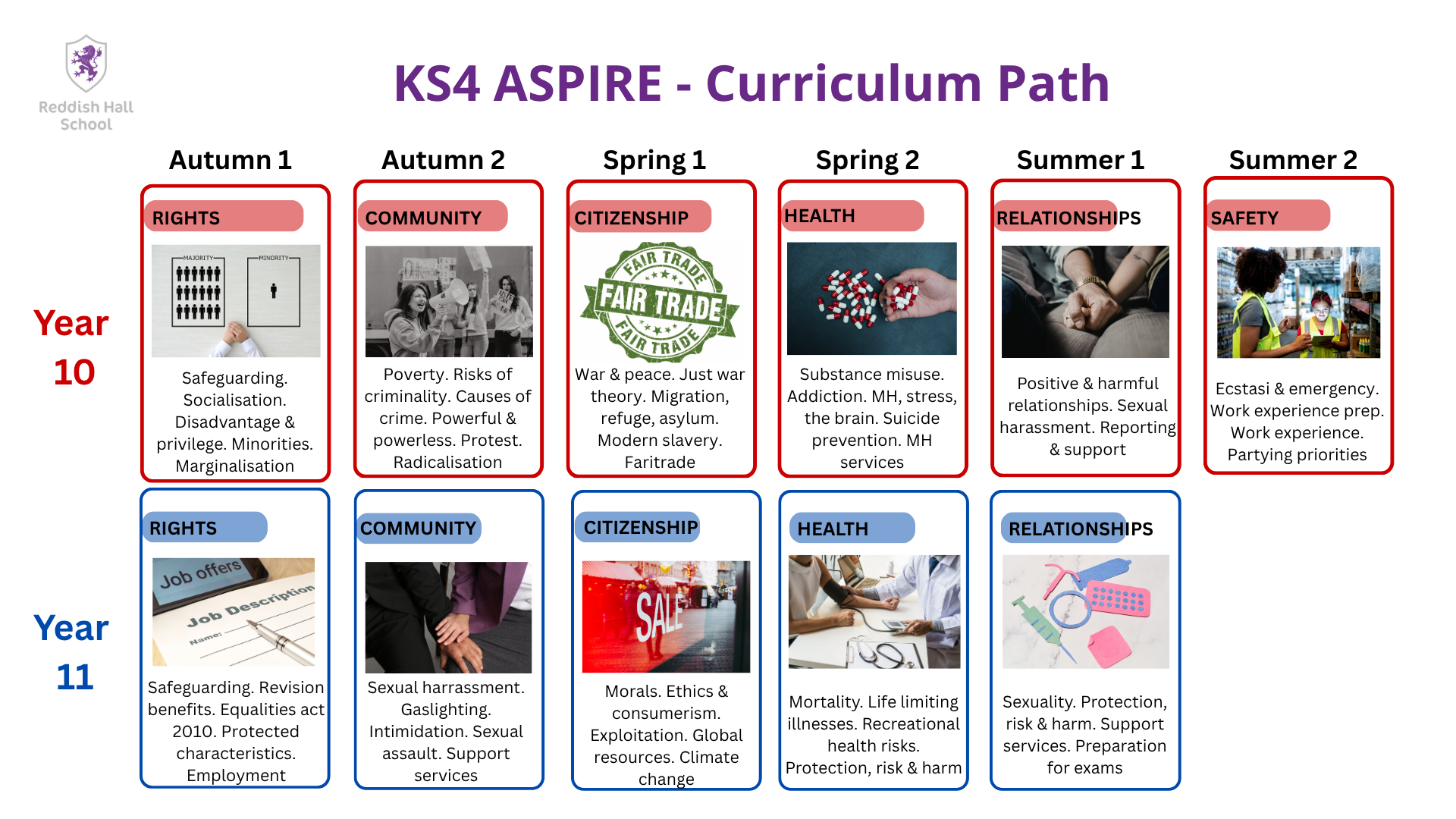
🔗 Download PDF version of KS4 ASPIRE
Curriculum Intent
ASPIRE brings together the statutory curriculum for Citizenship and Relationships, Sex and Health Education, helping pupils develop the knowledge, understanding and personal skills they need for life now and in the future. Through topics such as human rights, relationships, personal health, democracy, crime, safety and medical care, pupils learn how to make informed choices, keep themselves safe and understand their rights and responsibilities. The subject supports pupils in developing confidence, resilience, wellbeing and respect for others, while helping them to understand their role in their local community, in modern Britain and in the wider world. ASPIRE is an important part of safeguarding, personal development and preparation for adult life.
Progression of Skills and Knowledge
ASPIRE is carefully planned so that key themes are revisited over time in a structured, age-appropriate way. This allows pupils to deepen their understanding year by year, while building confidence in discussing sensitive and important topics. In Key Stage 3, pupils are introduced to core ideas, challenge misconceptions and develop an understanding of positive, healthy living. In Key Stage 4, this learning is extended through more mature discussion, case studies, research and the consideration of different viewpoints. Across the curriculum, pupils develop communication, reflection, analysis, debate and decision-making skills, while learning to apply their knowledge to real-life situations. The curriculum’s spiral structure also helps ensure that learning remains clear, connected and responsive to pupils’ needs over time.
Preparing for Next Steps
ASPIRE prepares pupils for adult life by developing the knowledge, confidence and personal skills needed to manage relationships, health, safety and participation in society. It supports pupils in becoming more informed, reflective and responsible young adults who are able to make safe decisions and understand the wider world around them. The subject also provides a strong foundation for further study in areas such as Health and Social Care, Psychology, Sociology, Philosophy and Ethics, Public Services, Criminology, Law and Childcare. More broadly, it helps pupils build the confidence and life skills they need for further education, employment and life beyond school.
Life Skills KS3 & 4
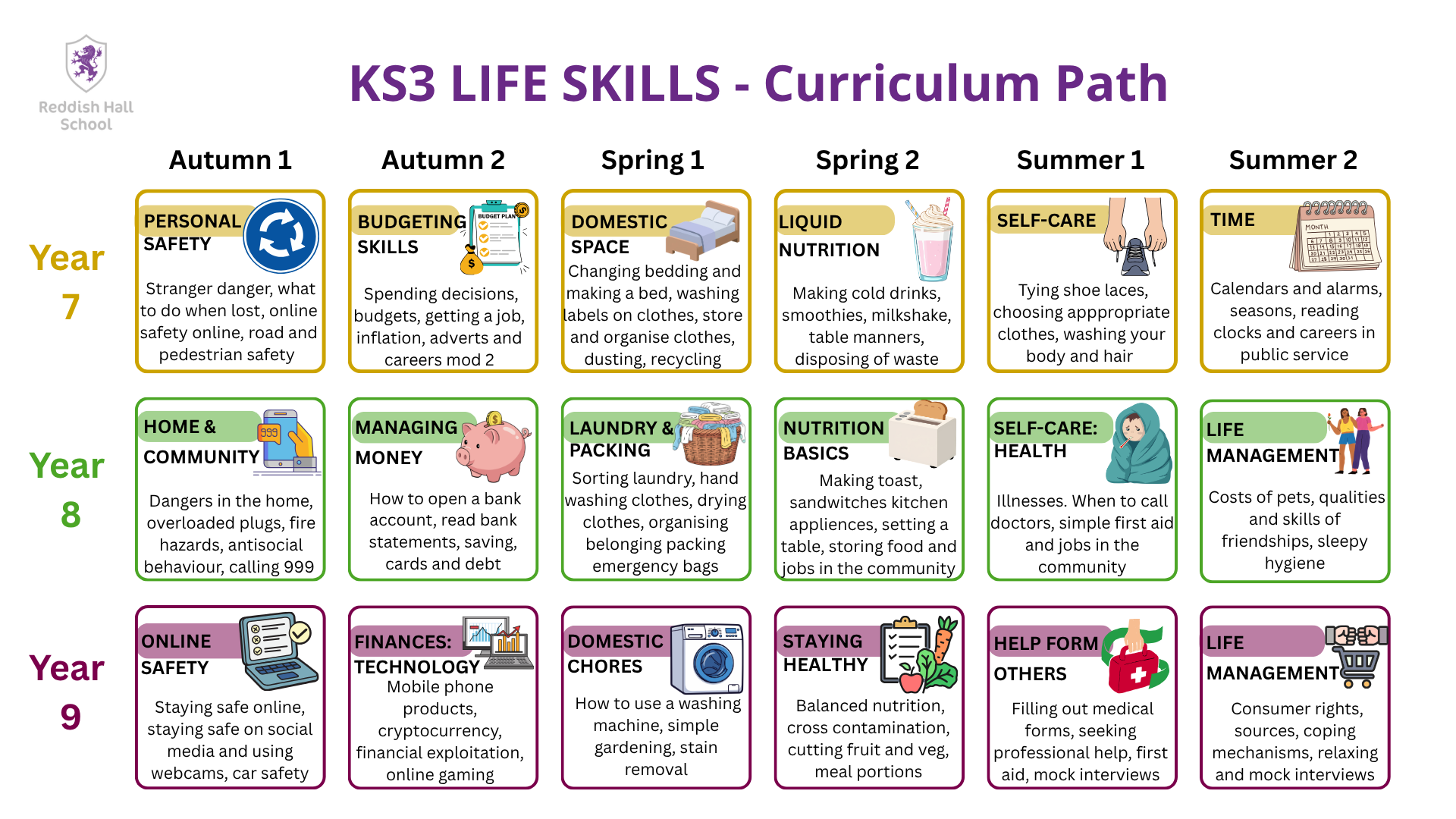
🔗 Download PDF version of KS3 Life Skills
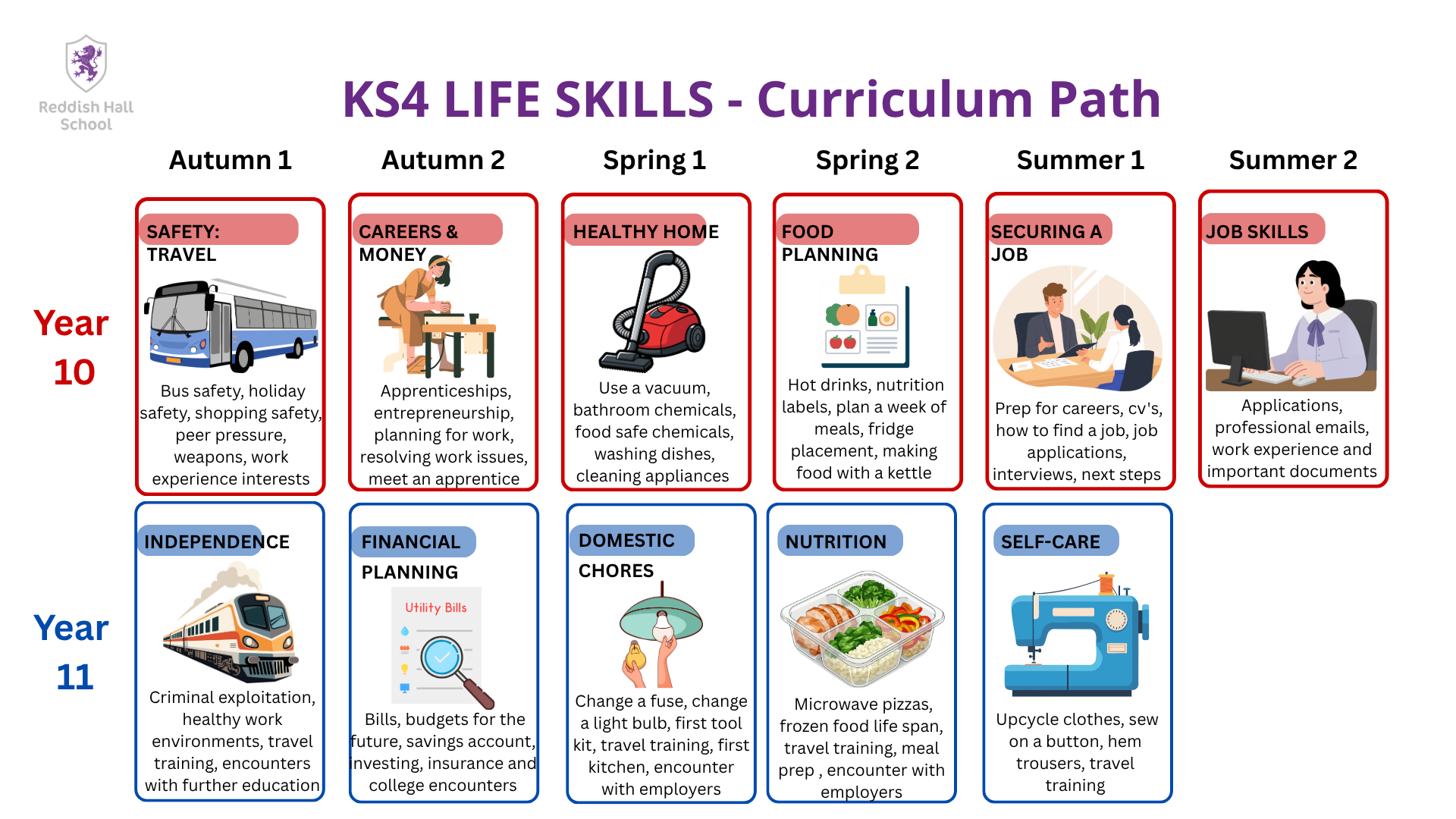
🔗 Download PDF version of KS4 Life Skills
Curriculum Intent
In Life Skills, we aim to equip pupils with the knowledge, skills and behaviours they need to become as independent as possible in adult life. The curriculum focuses on practical areas such as personal safety, financial awareness, domestic independence, nutrition, self-care, time management, careers and travel. Through real-life learning, pupils are supported to make informed, safe and confident decisions in their everyday lives. Life Skills also prepares pupils for further education, employment, community participation and independent living.
Progression of Skills and Knowledge
The Life Skills curriculum is carefully structured around key themes including safety, financial literacy, domestic independence, nutrition and meal preparation, self-care, life management, careers and travel. These areas are revisited over time with increasing challenge from Key Stage 3 through to Key Stage 5, so that pupils can build confidence and independence gradually. Learning includes practical activities, real-life scenarios and functional tasks that help pupils apply their skills in meaningful contexts. Communication, social interaction and problem-solving are woven throughout the curriculum, supporting pupils to develop the wider skills they need for everyday life.
Preparing for Next Steps
Life Skills prepares pupils for adulthood by helping them develop the confidence and practical abilities needed to manage daily life more independently. It supports them in making safe choices, looking after themselves, managing money, travelling more confidently and preparing for the world of work. The curriculum is closely linked to preparing for adulthood outcomes, helping pupils build the resilience, independence and decision-making skills they will need in future education, employment and life beyond school.
Maths KS3 & 4
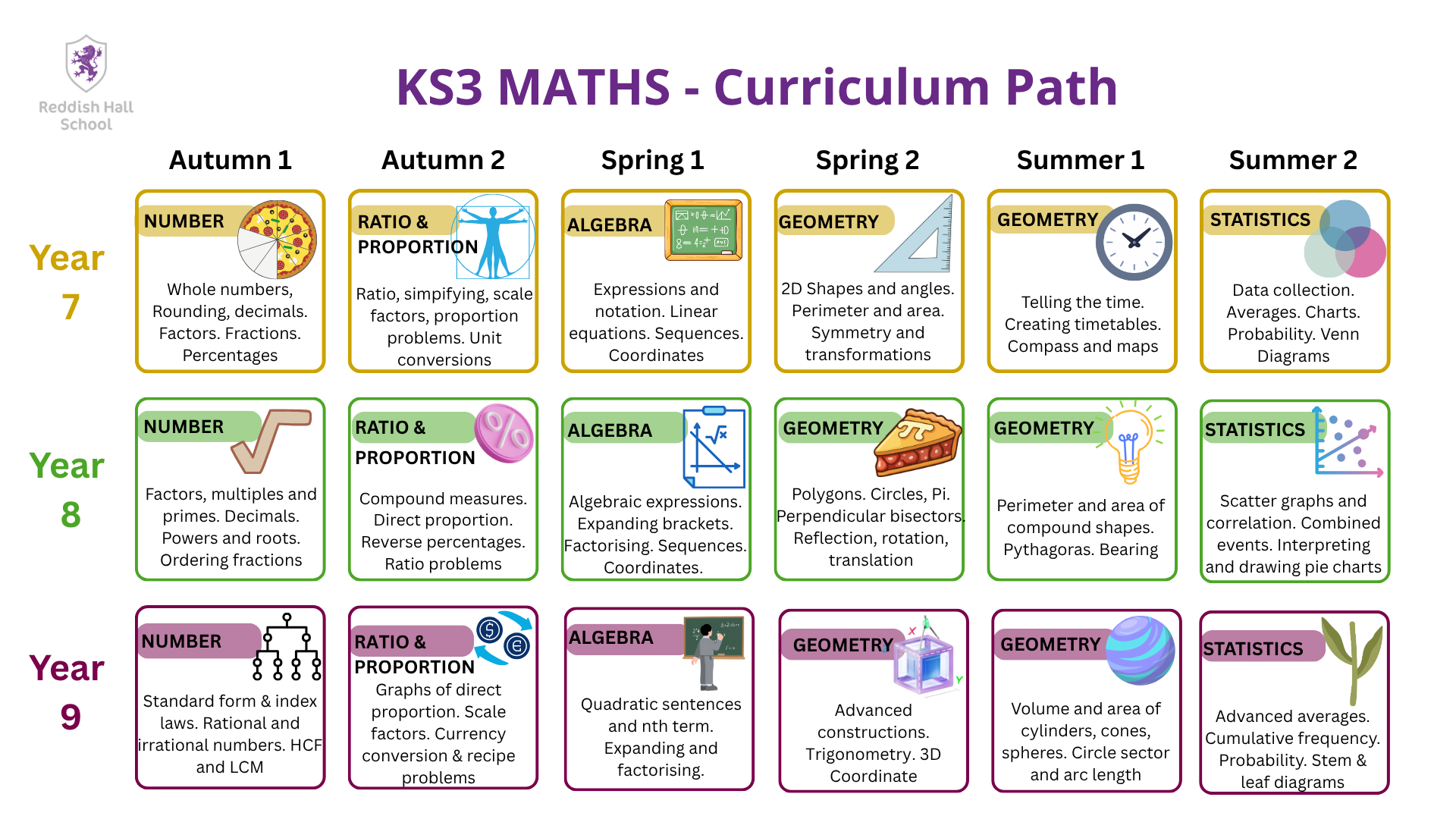
🔗 Download PDF version of KS3 Maths
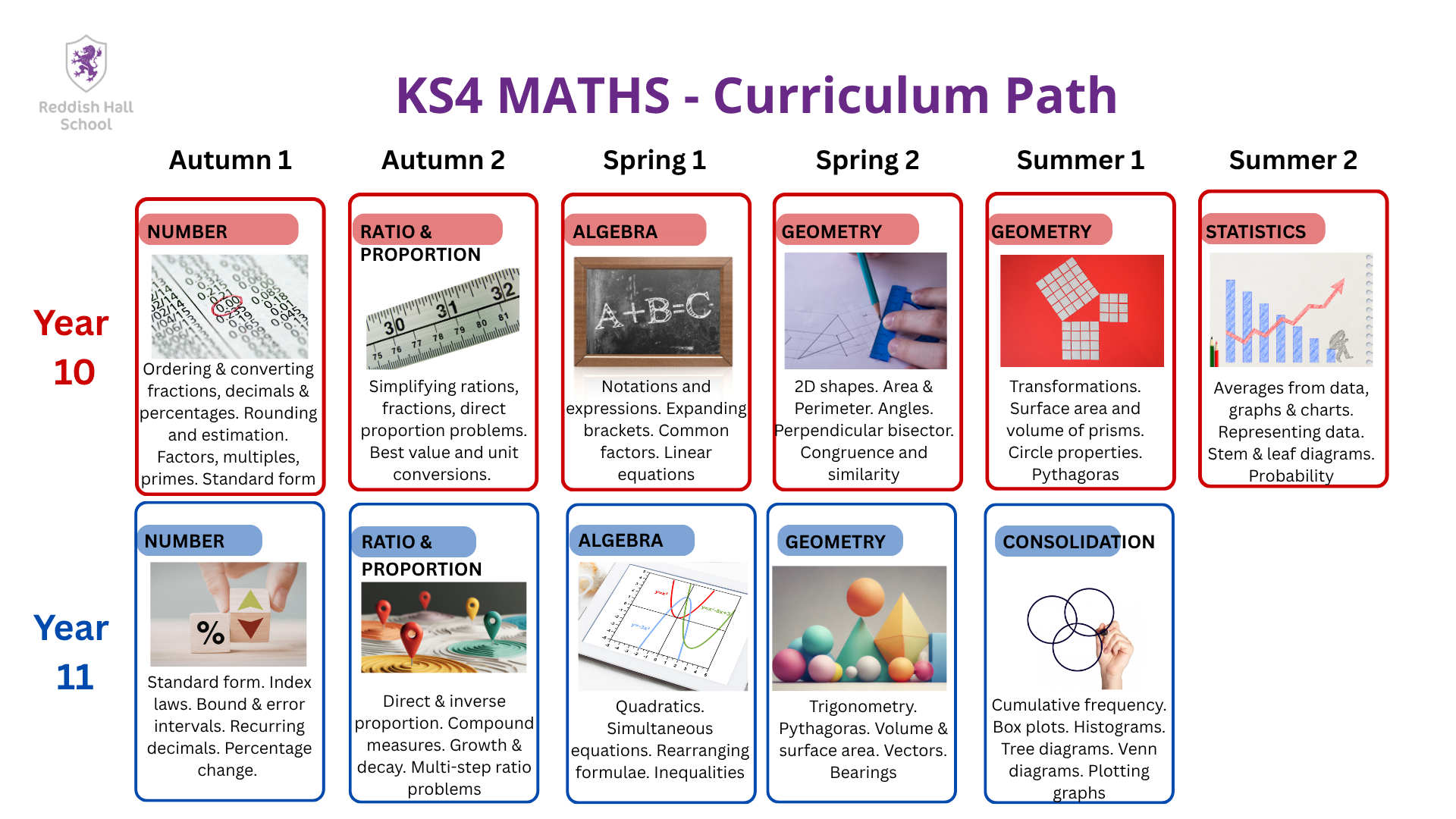
🔗 Download PDF version of KS4 Maths
Curriculum Intent
In Maths, we aim to help every pupil develop the knowledge, confidence and problem-solving skills they need to succeed in school and in everyday life. Mathematics is a vital life skill that enables pupils to understand the world, make informed decisions and become more independent. For many of our learners, Maths also provides structure, routine and opportunities to build resilience, perseverance and self-belief. Our curriculum is designed to ensure that all pupils can access and enjoy mathematics, develop confidence in their abilities, and recognise the importance of numeracy beyond the classroom.
Progression of Skills and Knowledge
Our Maths curriculum is based on the mastery approach developed by White Rose Education, which focuses on depth of understanding rather than moving on too quickly. Pupils build secure foundations before progressing to more complex concepts, with regular opportunities to revisit and consolidate previous learning. Over time, they develop conceptual understanding through concrete, pictorial and abstract representations, helping them to visualise and make sense of mathematical ideas. They also build fluency in number and calculation, reasoning skills, and the ability to solve problems in practical and meaningful contexts. Alongside this, pupils develop mathematical language, communication, independence and resilience, learning that mistakes are a valuable part of the learning process.
Preparing for Next Steps
Maths prepares pupils for a wide range of future pathways by developing both subject knowledge and essential life skills. Through their learning, pupils build confidence in numeracy, reasoning and problem-solving, while applying mathematics to practical contexts such as budgeting, measurement, data handling and everyday decision-making. This supports progression into GCSEs, Functional Skills, vocational courses, apprenticeships and employment, as well as helping pupils manage real-life situations with greater independence. Beyond qualifications, Maths also develops logical thinking, communication, resilience and adaptability, preparing pupils for further education, training and adult life.
Science KS3 & 4
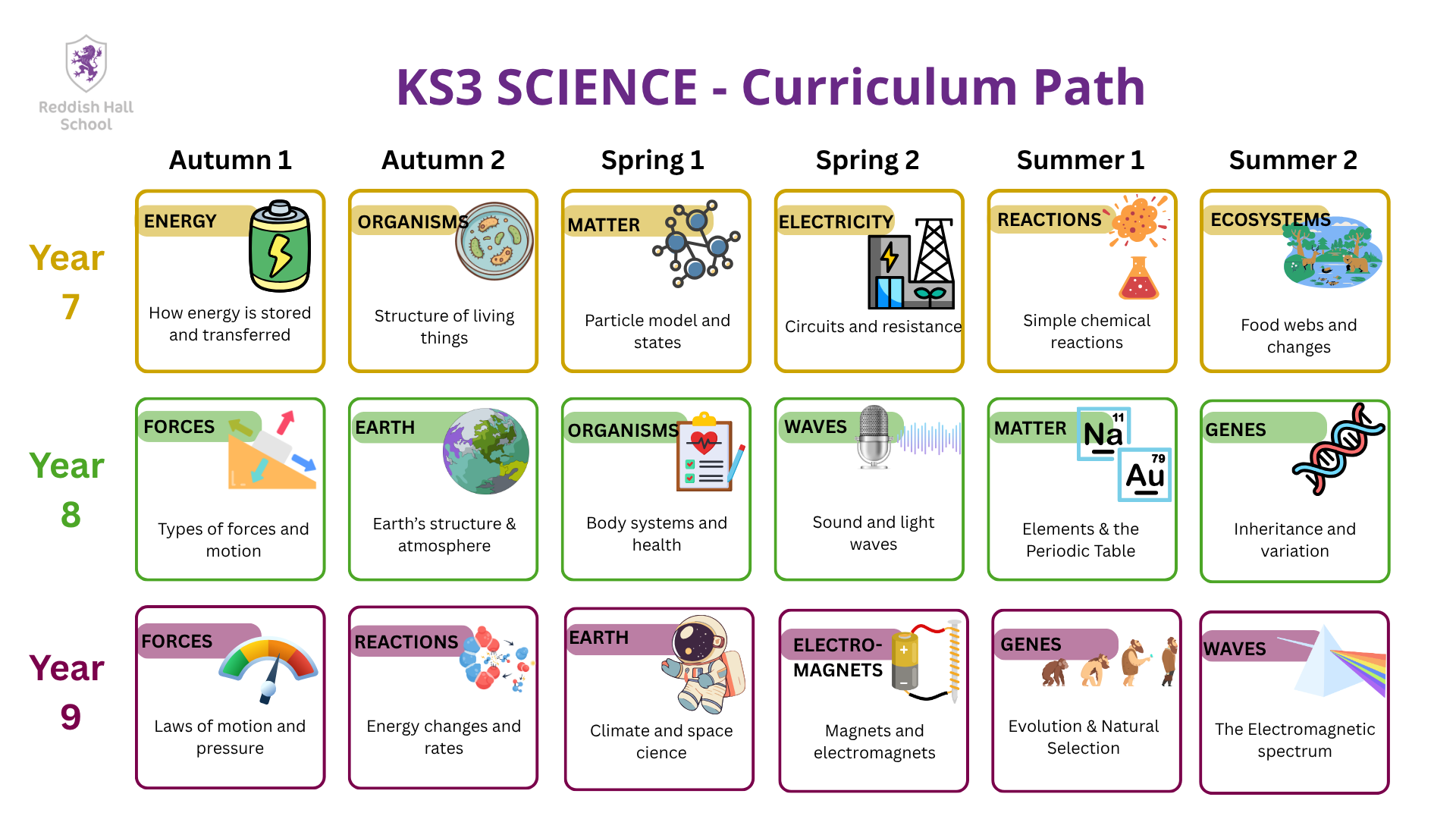
🔗 Download PDF version of KS3 Science
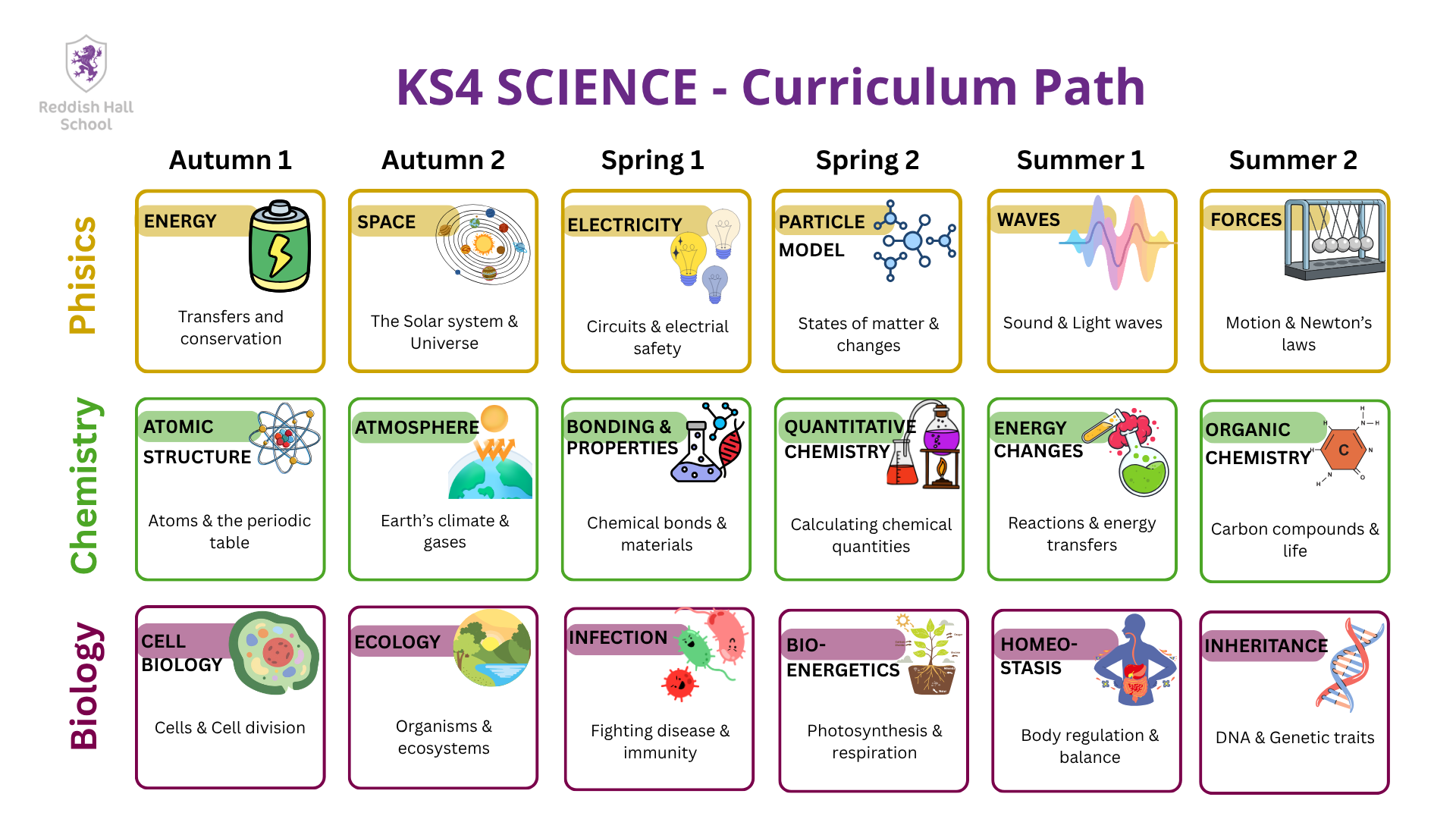
🔗 Download PDF version of KS4 Science
Curriculum Intent
In Science, we aim to nurture curiosity and help pupils explore the world through practical, hands-on learning. Pupils are encouraged to investigate, question and discover scientific ideas for themselves, building secure understanding through meaningful experience. Through the study of science, they learn to think critically, communicate their ideas clearly and recognise the importance of science in everyday life. Our curriculum is designed to develop confident, resilient learners who are curious about the world and motivated to understand it.
Progression of Skills and Knowledge
As pupils move through the Science curriculum, they build their knowledge and practical skills in a structured and supportive way. Learning is developed through regular investigation, teacher guidance and frequent opportunities to apply scientific understanding in different contexts. Pupils strengthen their ability to plan, carry out and evaluate practical work, while also developing their scientific vocabulary, observation skills and understanding of key concepts. Ongoing assessment, including questioning, quizzes, feedback and practical observation, helps teachers identify misconceptions and support pupils’ progress over time. This ensures that learning is secure, meaningful and rooted in growing confidence as young scientists.
Preparing for Next Steps
Science prepares pupils for a range of future pathways by developing scientific knowledge, practical skills and the confidence to investigate and solve problems. For some pupils, this provides a foundation for further study in science or related subjects at college. For all pupils, science supports the development of critical thinking, data handling, communication and informed decision-making that are valuable in everyday life. Our aim is to help pupils leave school with the curiosity, understanding and confidence to engage with a world increasingly shaped by science.
Key Stage 3
Computing KS3
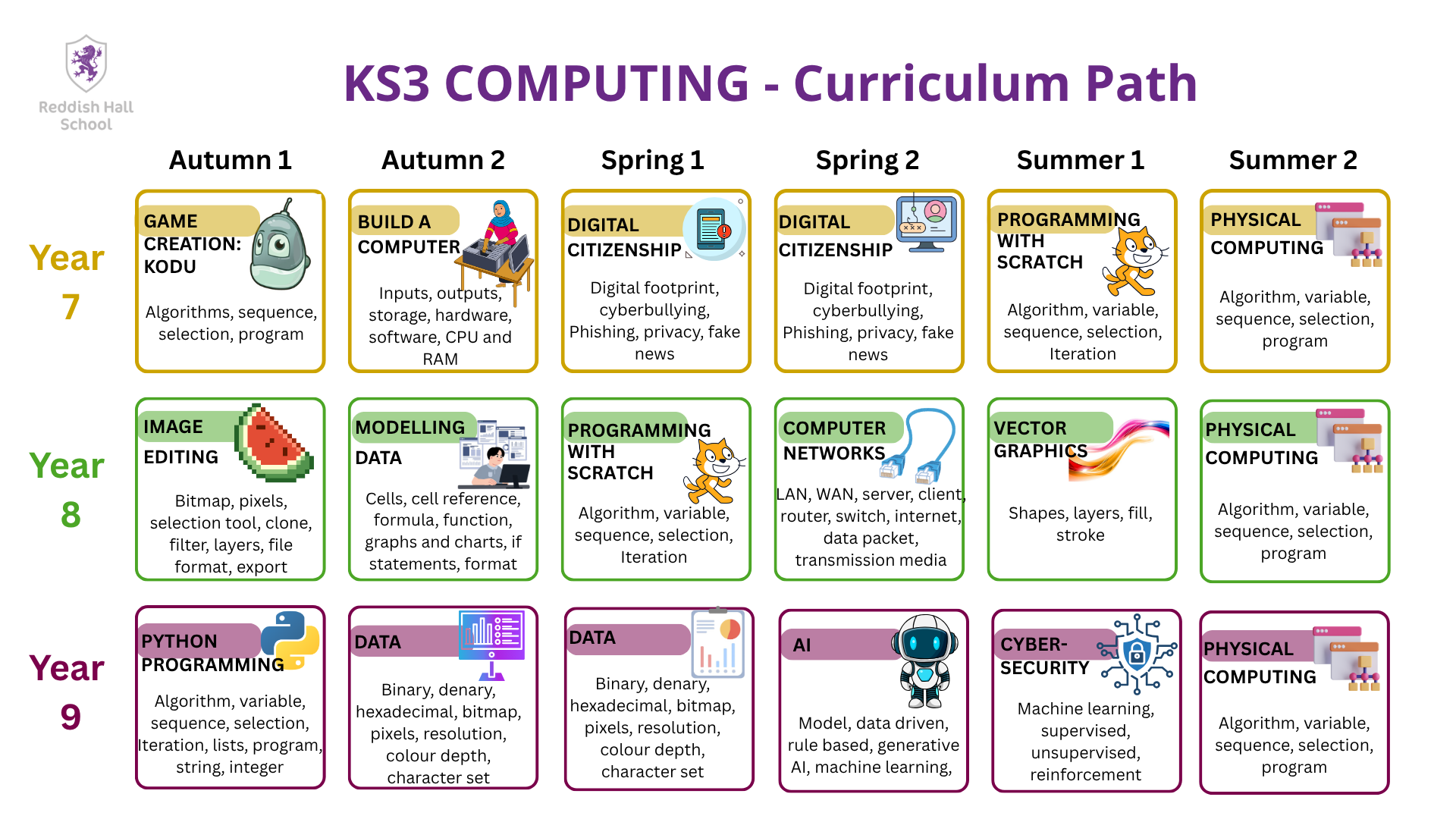
🔗Download the PDF version for KS3 Computing
Curriculum Intent
In Computing, we aim to give all pupils the knowledge, skills and understanding they need to succeed in an increasingly digital world. The curriculum is built around the three main areas of the National Curriculum: Computer Science, Information Technology and Digital Literacy. Through these areas, pupils learn how digital systems work, how to use technology effectively, and how to stay safe and responsible online. Computing encourages logical thinking, creativity, resilience and problem-solving, while helping pupils become confident and thoughtful users of technology in school and beyond.
Progression of Skills and Knowledge
As pupils move through the curriculum, they build their understanding in a clear and supportive sequence. In programming, they progress from simple algorithms and block-based coding to more advanced programming concepts using text-based languages such as Python. In their understanding of hardware, software and networks, pupils move from learning about the parts of a computer to exploring how more complex digital systems and networks operate. They also develop their digital literacy by learning about online safety, cyberbullying, digital footprints, cyber security and the wider ethical impact of technology. Alongside this, pupils learn to create and evaluate digital work, from using Office software to image editing, vector graphics and spreadsheet modelling. Their understanding of data also develops over time, from basic ideas such as pixels and binary representation to more advanced knowledge of how computers store and process information. Learning is carefully structured so that all pupils, including those who may have gaps in prior learning, can access the subject successfully and build confidence over time.
Preparing for Next Steps
Computing prepares pupils for further study and for life in a digital society. It provides a strong foundation for Key Stage 4, including pathways such as GCSE Computer Science, while also developing practical digital skills that support learning across the curriculum. Pupils learn how to solve problems, think logically, use technology purposefully and make safe, informed decisions online. These are important skills not only for future education, but also for employment, communication and everyday life in the modern world.
Geography KS3
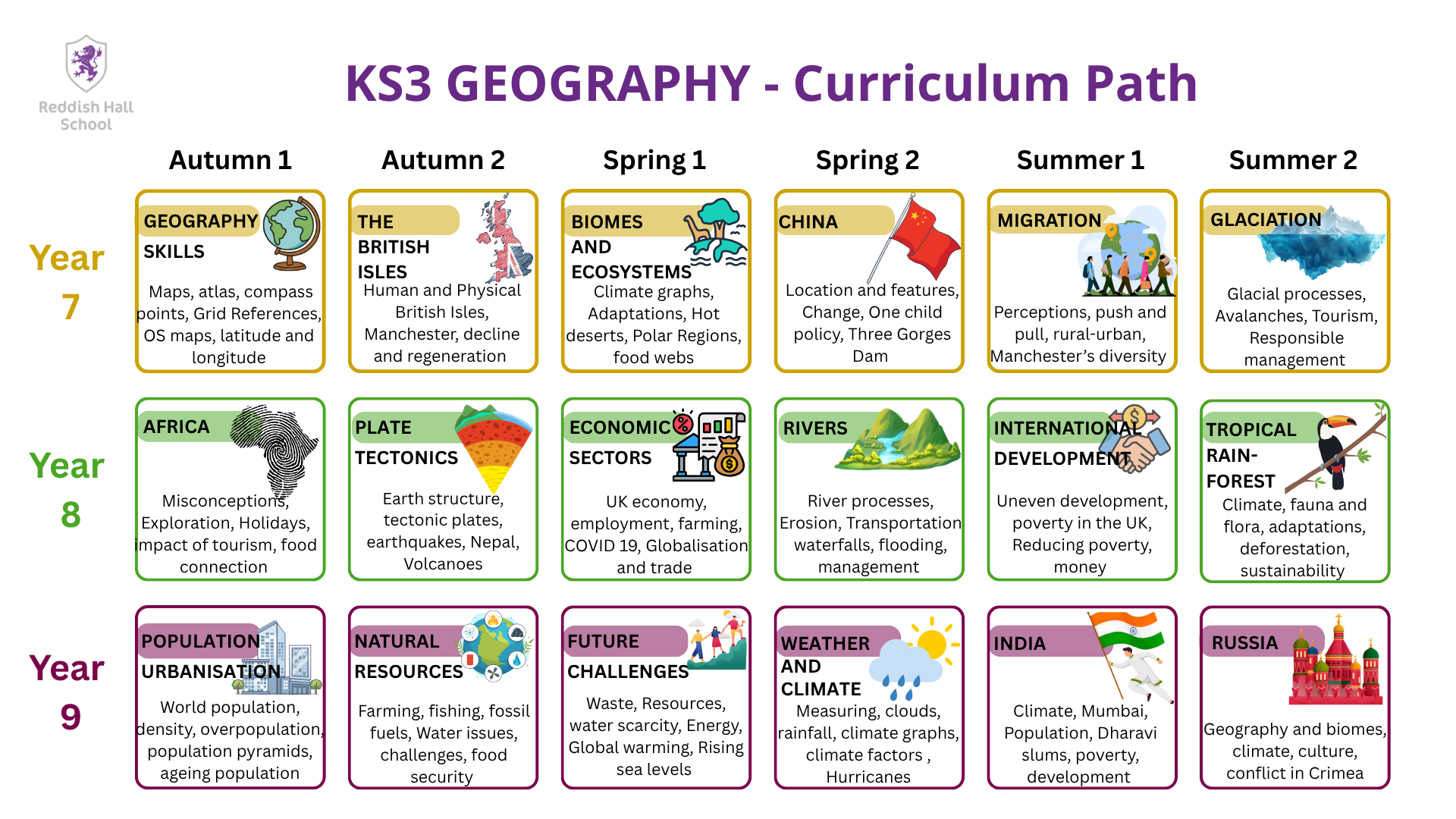
🔗 Download the PDF version of KS3 Geography
Curriculum Intent
In Geography, we aim to give all pupils access to the core aims of the National Curriculum by helping them develop secure knowledge of places, environments and the processes that shape the world. Pupils explore geography at local, national and global scales, learning about both physical features and human activity. Through meaningful, real-world topics, they begin to understand how people and environments interact, and how issues such as sustainability, inequality and global interdependence affect the world around them. Geography encourages curiosity, informed discussion and a growing awareness of the challenges facing the future.
Progression of Skills and Knowledge
As pupils move through the curriculum, they develop their geographical understanding in a clear and structured way. They begin by identifying and describing physical and human features, before progressing to explaining how people and environments influence one another and why different places are affected in different ways. Pupils also build important geographical skills over time, including map reading, data interpretation, fieldwork, enquiry and decision-making. As their confidence grows, they learn to analyse evidence, compare viewpoints and justify their ideas using accurate geographical vocabulary. These skills are revisited through a range of topics so that learning becomes deeper, more connected and increasingly independent.
Preparing for Next Steps
Geography prepares pupils for Key Stage 4 by developing confidence in geographical vocabulary, explanation, extended writing and the use of evidence to support ideas. Pupils learn to interpret maps, graphs and data with increasing independence, and to make reasoned judgements about important geographical issues. Through regular practice and retrieval, they become better prepared to understand more complex concepts and respond to more demanding assessments. Beyond school, Geography also helps pupils develop the awareness, curiosity and critical thinking needed to understand the wider world and their place within it.
History KS3
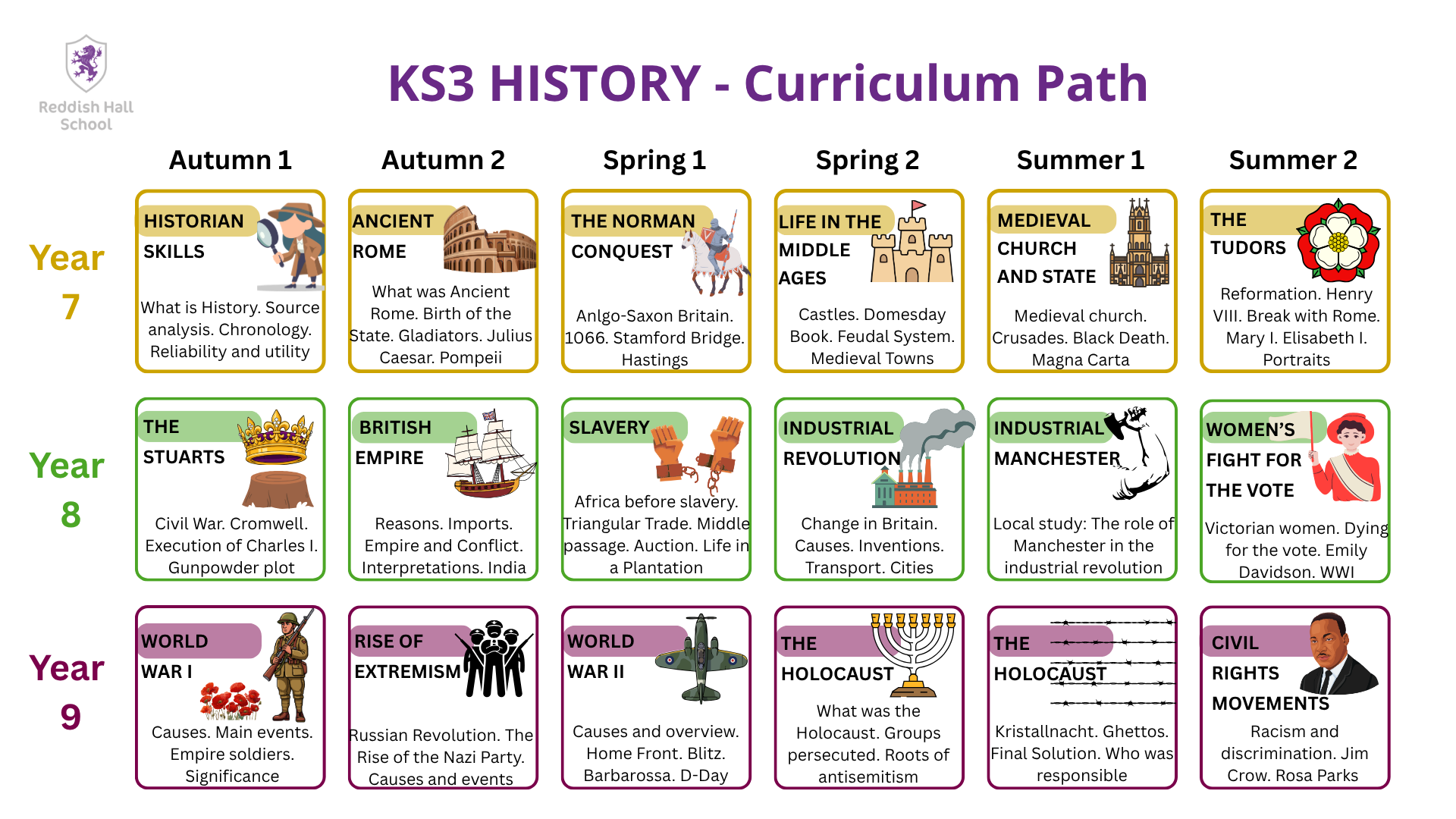
🔗 Download the PDF version of KS3 History
Curriculum Intent
In History, we aim to give all pupils access to the core aims of the National Curriculum through adapted, engaging lessons that build understanding over time. Pupils explore important people, events and periods from the past while developing a sense of chronology, change and cause and consequence. Through this, they learn to think carefully, ask questions, and discuss ideas respectfully. History also helps pupils develop empathy, cultural understanding and awareness of how the past has shaped the world around them.
Progression of Skills and Knowledge
As pupils move through the curriculum, they build their historical knowledge and understanding in a carefully planned sequence. They begin by recognising key events and differences between time periods, and gradually develop the ability to explain changes over time, explore causes and consequences, and understand why some events are historically significant. Pupils also learn how to use sources of evidence, moving from simple observation to considering reliability, bias and interpretation. Over time, they become more confident in communicating their ideas through discussion, written work and structured historical enquiry.
Preparing for Next Steps
History prepares pupils well for Key Stage 4 by developing important skills such as enquiry, evidence analysis and written communication. It also strengthens literacy, memory, reasoning and the ability to justify opinions, which supports progress across a wide range of subjects. Beyond school, History helps pupils understand different perspectives, recognise change over time, and make informed judgements. In this way, it supports the development of confident, thoughtful young people who are ready to participate meaningfully in modern society.
Religious Studies KS3
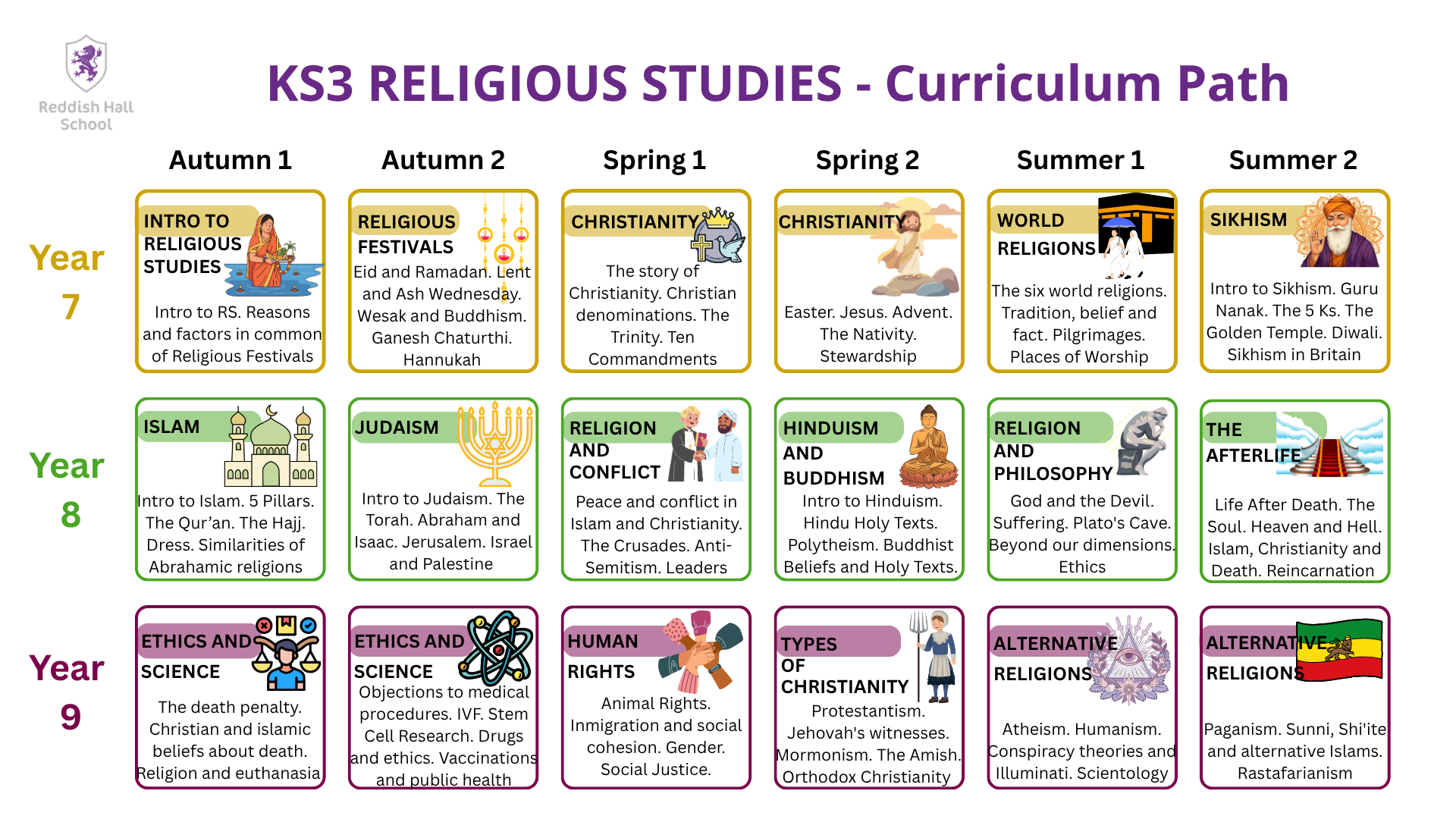
🔗 Download the PDF version of KS3 Religious Studies
Curriculum Intent
In Religious Studies, we aim to help pupils develop an understanding of world religions, beliefs and non-religious worldviews, and how these shape individuals, communities and society. Through carefully planned topics, pupils explore faith, philosophy and ethics in ways that are accessible, meaningful and relevant to their lives. The subject encourages empathy, tolerance and cultural understanding, helping pupils to appreciate diversity, identity and belief in modern Britain and the wider world. Lessons are adapted to support engagement, discussion and reflection so that all learners can take part successfully.
Progression of Skills and Knowledge
As pupils move through the curriculum, they develop their knowledge and understanding of religious and non-religious beliefs in a structured way. They begin by recognising key beliefs, symbols and practices, and gradually progress to explaining similarities, differences and the significance of these within different worldviews. Pupils also learn to interpret religious stories, texts and symbols, using them to deepen their understanding of values, traditions and ways of life. Over time, they become more confident in discussing ethical and philosophical questions, justifying their opinions and considering different viewpoints with respect. Their communication and reflection also develop, moving from simple responses to more thoughtful discussion and structured explanations using appropriate subject vocabulary.
Preparing for Next Steps
Religious Studies prepares pupils for future learning by developing ethical reasoning, respectful discussion and an understanding of belief, identity and diversity. These skills support progress in subjects such as Citizenship, PSHE and across the wider curriculum. The subject also helps pupils build confidence in evaluating different perspectives, justifying their views and engaging thoughtfully with moral and social issues. Beyond school, Religious Studies supports pupils in becoming reflective, respectful and informed individuals who are ready to take part in life in a diverse modern society.
Key Stage 4
Computing KS4
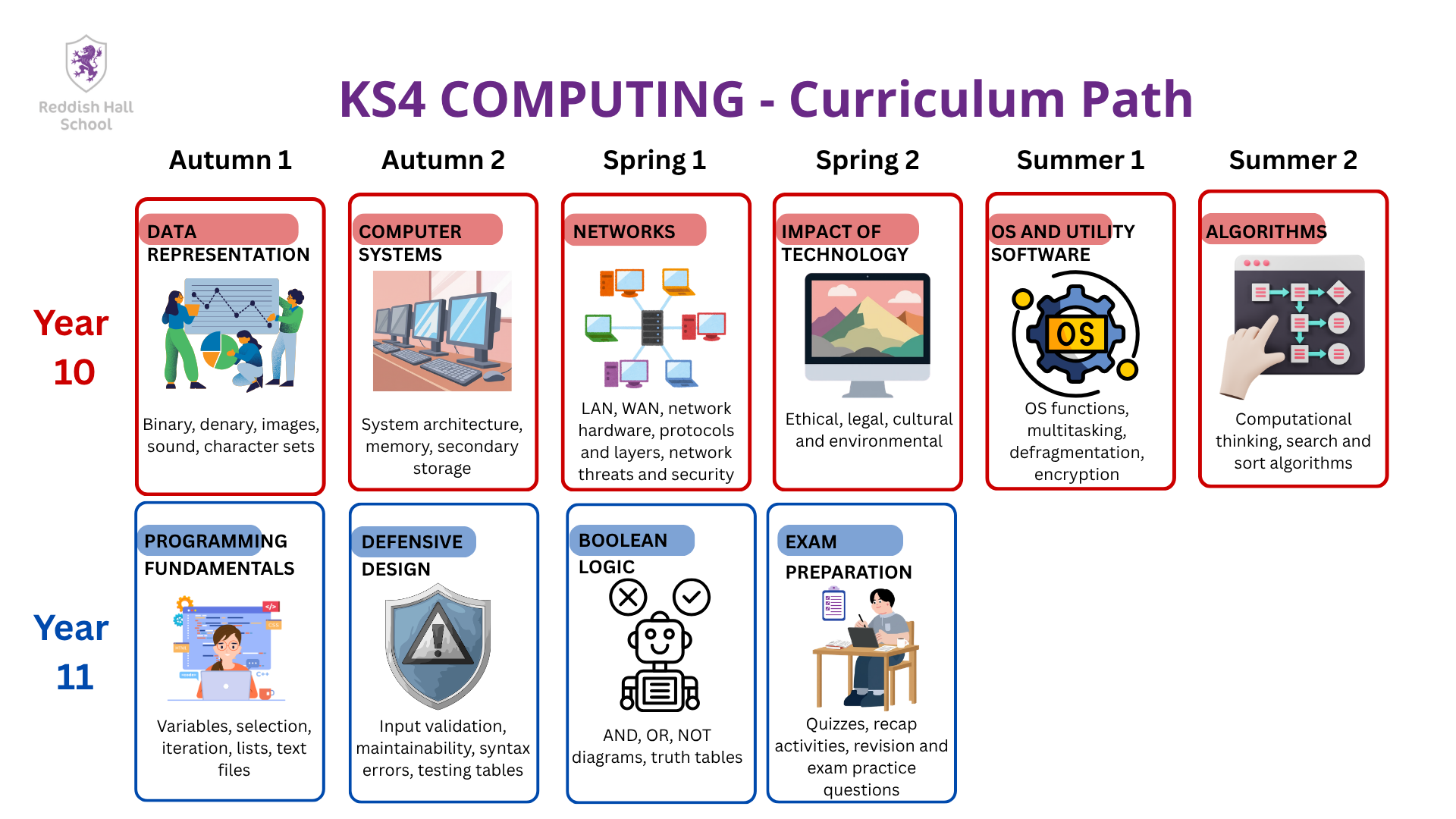
🔗 Download the PDF version of KS4 Computing
Curriculum Intent
At Key Stage 4, Computing helps pupils develop the knowledge, understanding and practical skills they need to succeed in a digital world. Pupils can follow different pathways, including GCSE Computer Science, Thinking as a Coder, ICDL and Creative iMedia, allowing them to build on their strengths and interests. Across these courses, pupils learn how computer systems work, how to solve problems logically, and how to use digital tools confidently and effectively. They also develop creativity, resilience and independence through programming, digital production and the use of industry-standard software.
Progression of Skills and Knowledge
As pupils move through the KS4 Computing curriculum, they deepen their understanding of computing concepts and strengthen their practical digital skills. In Computer Science, they develop their knowledge of algorithms, computational thinking, programming, system architecture, memory and storage. They learn to design solutions, write more complex programs and understand the wider ethical, legal, cultural and environmental impact of technology. In ICT- and media-based courses such as ICDL and Creative iMedia, pupils become increasingly confident in using a range of digital tools and software to create, analyse and improve digital products for different audiences and purposes. Over time, they build greater independence, adaptability and confidence in applying technology in purposeful and creative ways.
Preparing for Next Steps
Computing at KS4 prepares pupils for a range of future pathways, including A-levels, vocational IT and media courses, apprenticeships and employment in digital and creative industries. GCSE Computer Science provides a strong foundation for further study in areas such as programming, cyber security, software development and data-related fields. Creative iMedia and ICDL support progression into practical digital pathways, including design, media production, marketing and other technology-based roles. Across all pathways, pupils also develop highly transferable skills such as problem-solving, time management, independent working and resilience, helping to prepare them for further education, training and adult life.
Geography KS4
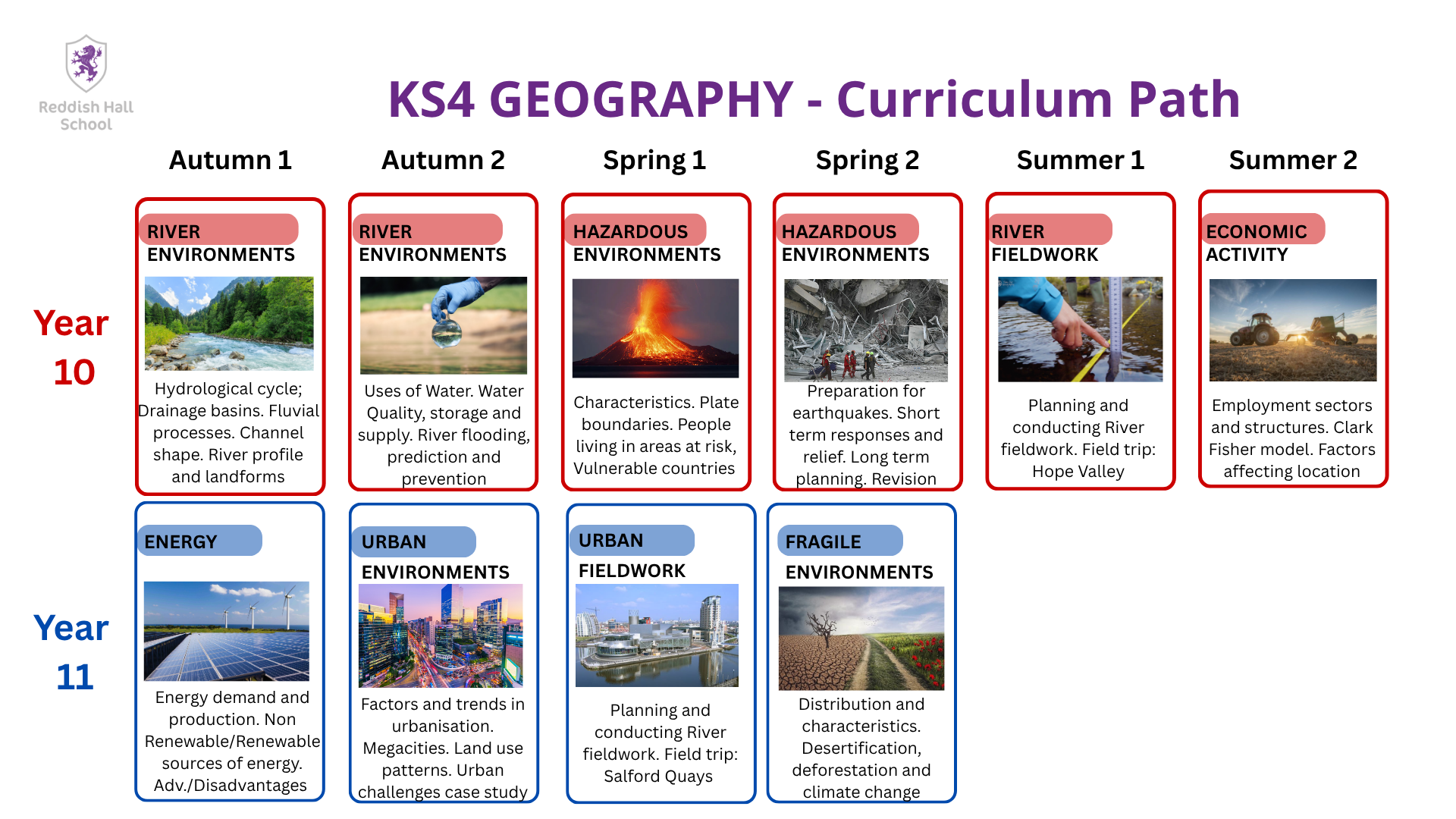
🔗 Download the PDF version of KS4 Geography
Curriculum Intent
At Key Stage 4, Geography helps pupils develop a deeper understanding of the physical and human processes that shape the world around them. Through the Edexcel IGCSE Geography course, pupils study a range of important topics including climate change, urbanisation, resource management and global inequality. The curriculum is designed to help pupils make sense of places, environments and current global challenges, while developing curiosity, environmental awareness and informed judgement. Teaching is carefully adapted so that all learners can access the course successfully and build confidence in a demanding subject.
Progression of Skills and Knowledge
As pupils move through the KS4 Geography course, they build secure knowledge of both physical and human geography in a clear and structured way. They progress from identifying features and processes to explaining more complex systems and the links between people and environments at local, national and global scales. Pupils also strengthen their geographical skills, including map work, data interpretation, fieldwork understanding, analysis and evaluation. Over time, they become more confident in interpreting graphs, maps, images and unfamiliar information, and in communicating their ideas through structured, subject-specific written responses. Regular practice, modelling and retrieval help pupils deepen their understanding and prepare for examination success.
Preparing for Next Steps
KS4 Geography prepares pupils for success in IGCSE assessment by developing extended writing, data-response skills, case study knowledge and fieldwork-based enquiry. Pupils are supported to build independent revision habits through the use of knowledge organisers, case study materials and retrieval practice, helping them become more confident and self-reliant learners. The subject also prepares pupils for life beyond school by developing decision-making, critical thinking and the ability to interpret evidence and form balanced judgements about real-world issues. These are valuable skills for further study, employment and active participation in modern society.
History KS4
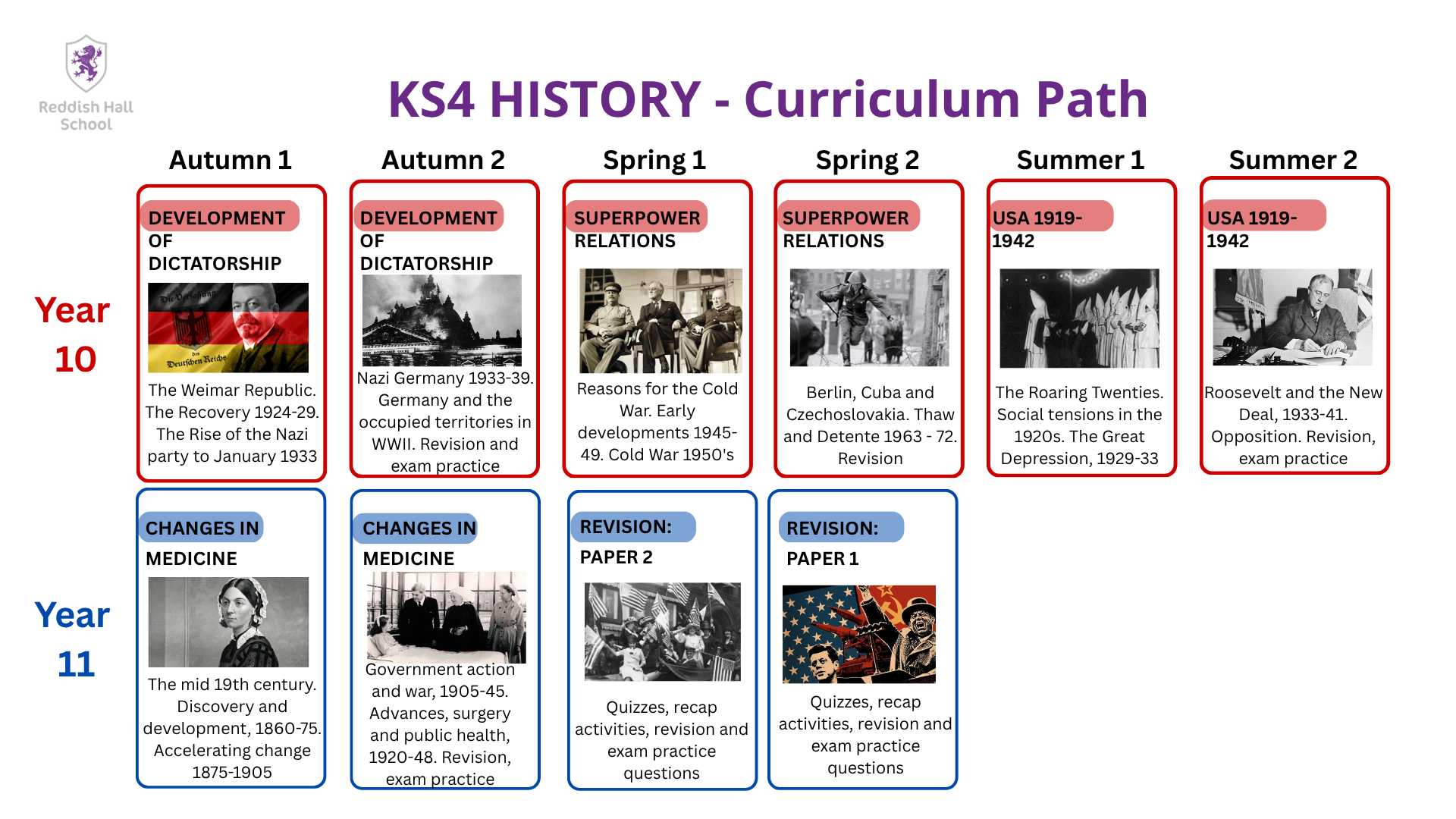
🔗 Download the PDF version of KS4 History
Curriculum Intent
At Key Stage 4, History helps pupils develop a deeper understanding of the key events and developments that shaped the modern world. Through the study of topics such as Germany, the USA, Superpower Relations and Changes in Medicine, pupils explore how societies change over time and how leadership, conflict, ideas and decisions influence people’s lives. The curriculum is carefully structured so that all learners can access challenging historical content, with teaching approaches that support understanding, confidence and success. History at this stage also encourages pupils to think critically, consider different perspectives and make informed judgements based on evidence.
Progression of Skills and Knowledge
As pupils move through the KS4 History course, they continue to strengthen both their historical knowledge and their analytical skills. They build a more detailed understanding of change and continuity, cause and consequence, significance and interpretation across a range of historical periods and themes. Pupils learn how to work with sources and interpretations in increasing depth, moving from identifying simple information to analysing reliability, viewpoint and historical value. They also develop their communication and enquiry skills, progressing towards clear, structured, evidence-based written answers and more independent historical thinking. Regular retrieval, guided practice and carefully sequenced support help pupils build confidence and prepare effectively for examination demands.
Preparing for Next Steps
KS4 History prepares pupils for success in IGCSE assessment by developing extended writing, source analysis, interpretation skills and the ability to construct well-supported arguments. Pupils are encouraged to build effective revision habits, use knowledge organisers confidently and become more independent in their learning as they move through the course. Beyond the exam, History supports the development of critical thinking, informed judgement and perspective-taking, all of which are valuable in further study, employment and adult life.
Psychology KS4
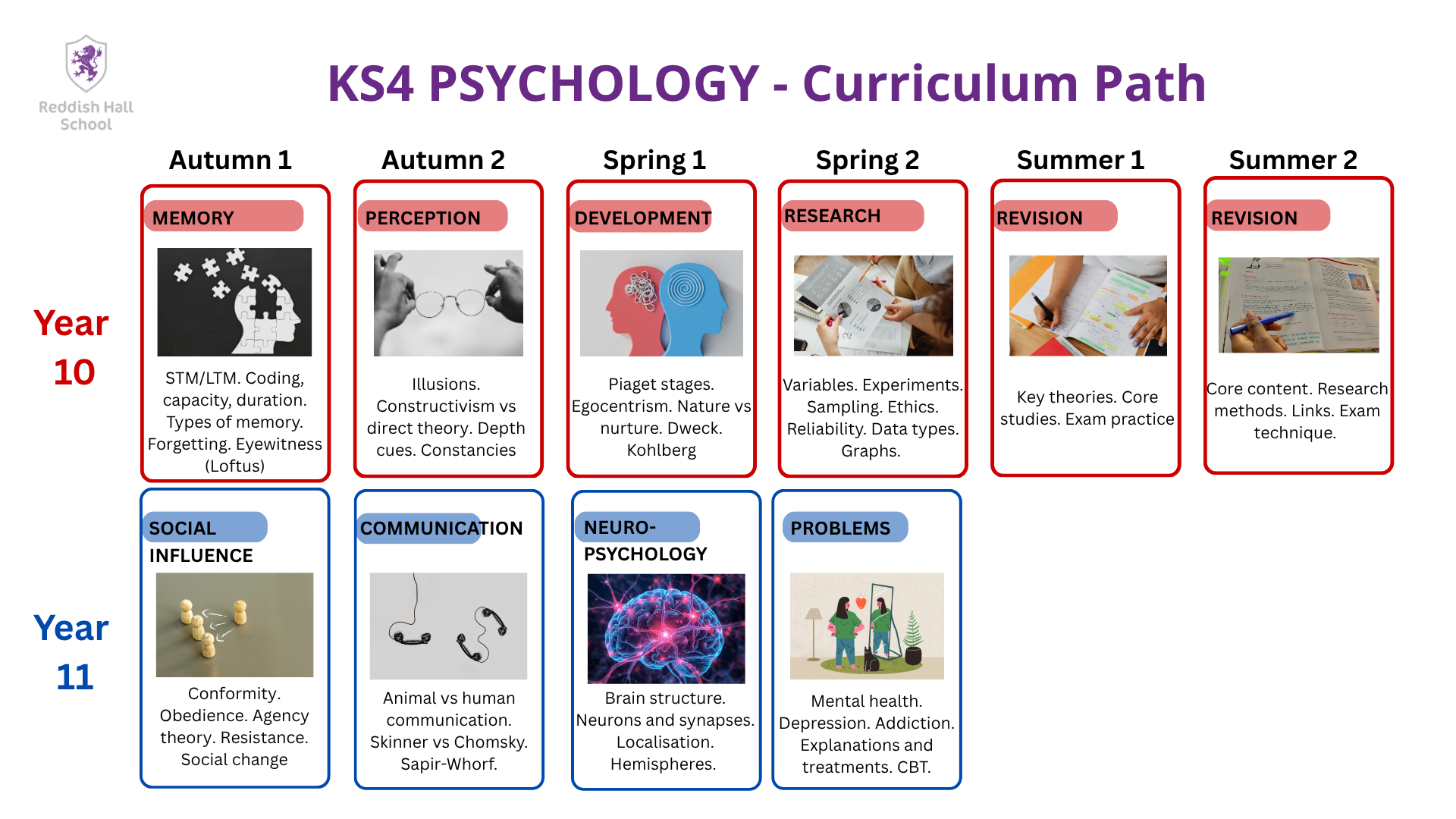
🔗 Download the PDF version of KS4 Psychology
Curriculum Intent
At Key Stage 4, Psychology helps pupils develop an understanding of human behaviour and mental processes, enabling them to explore why people think, feel and act in different ways. Through the AQA GCSE Psychology course, pupils study key topics such as memory, perception, development, social influence and research methods. The subject encourages curiosity, critical thinking and thoughtful discussion, while helping pupils understand how psychological ideas can be applied to real-life situations. Psychology also supports pupils in developing the knowledge and confidence needed for GCSE success and future study.
Progression of Skills and Knowledge
As pupils move through the course, they build secure knowledge of key psychological theories, studies and concepts using accurate subject vocabulary. They develop their ability to apply this knowledge to both familiar and unfamiliar situations, making links between classroom learning and real-world examples. Over time, pupils strengthen their analytical and evaluative skills, progressing from identifying simple strengths and weaknesses to comparing theories, judging evidence and constructing balanced arguments. They also build confidence in research methods and data skills, learning how to understand variables, interpret information and consider reliability, validity and ethics across different areas of psychology.
Preparing for Next Steps
Psychology prepares pupils for further study at A Level and for vocational pathways linked to psychology, health and social care, and the social sciences. The subject develops a range of valuable transferable skills, including critical thinking, evidence-based reasoning, structured writing and the ability to apply knowledge clearly and accurately. It also helps pupils explore important real-world issues such as behaviour, decision-making and mental health. Through this, Psychology supports pupils in becoming more independent, analytical and reflective learners, ready for further education, training and adult life.